Showing posts with label stop the hate. Show all posts

Sunday, December 7, 2008

Indian Muslims Protest Terrorist Attacks in India


Not all terrorists are Muslim and not all Muslims are terrorists!!!!  Everybody suffers from terrorism, and nobody wins! 

THE HATE NEEDS TO STOP!


Today's blog post has 3 sets of information:

1.  A poem by Sufi poet *Rumi* on God.  *Sufism* is a form of Islam.  Like any of the world's major faiths, there are multiple ways to practice Islam.
  • A note on Sufism:  The current War on Terror has probably made a lot of people aware of the term Jihad, or Holy War.  In Sufism, Jihad would be defined as an internal struggle - a battle against forces that would seek to do bad, or work evil through you.  Just like the Christian faith, not everyone interprets religious definitions literally.

2.  An article on the protests against the attacks in Mumbai, India by Indian Muslims.  You can access this article directly by *clicking here*

3.  An article about how Muslims around the world condemn the attacks in India, and are worried about the negative impact these attacks have on them and thier faith. You can access this article by *clicking here*.


Where is God?  
By Rumi

I tried to find Him on the Christian cross, but He
was not there; I went to the Temple of the
Hindus and to the old pagodas, but I could not
find a trace of Him anywhere.

I searched on the mountains and in the valleys
but neither in the heights nor in the depths was I
able to find Him. I went to the Ka’bah in Mecca,
but He was not there either.

I questioned the scholars and philosophers but
He was beyond their understanding.

I then looked into my heart and it was there
where He dwelled that I saw Him; He was
nowhere else to be found.


Muslims denounce Mumbai attackers as enemy of Islam
8 Dec 2008, 0206 hrs IST, Roana Maria Costa & Mohammed Wajihuddin, TNN
MUMBAI: Outraged at the recent terrorist attacks on Mumbai and terrorists who have painted a distorted image of Muslims in the name of Islam, hundreds of Muslim men, women and children publicly denounced all the killers of innocents as enemies of Islam on Sunday. The protesters, which included several members from Bollywood, also said that the enemies of India were enemies of Muslims too. 

On Sunday afternoon, a silent march of the Muslims started from the CST station, one of the places the terrorists had chosen to create mayhem on 26/11, winding its way through Churchgate to the sea-front near the Oberoi-Trident. Similar protest walks, condemning terrorist outfits like the Al Qaeda, Taliban, ISI, LeT and SIMI and Huji were simultaneously held in cities like Bangalore, Ahmedabad, Indore, Hyderabad and Delhi. 

"We disown and denounce all those who kill in the name of Jihad. Terrorists are fascists and enemies of Muslims since Islam doesn't preach killing of innocents," said poet-lyricist Javed Akhtar. 

Akhtar said 26/11 attacks were unprecedented and were attacks on the dignity of the country. "Fascists are those who distort religion. There are bad elements in all religions. On 26\11 they didn't just place bombs and run, they entered our buildings, killed people and held hostages. No religion preaches killing of innocents," he said. 

26\11 has changed the psyche of Indians, he said. "For the first time I've seen tears in so many eyes, people with so much grief," he said. 

Perhaps for the first time liberal Muslims were joined by the clerics coming from organisations like Jamiat-ul-Ulema in expressing their anger against the terror outfits who have hijacked Islam. Actor-TV anchor Javed Jaffri said the Muslims had to speak out openly because after all it's Islam which is being maligned. "There is nothing called Islamic terrorists. Islam is being misinterpreted by some groups. They kill people in the name of jihad. A religion which asks its members to greet each other with Assalamu Alaikum (peace be with you) could never sanction killing of innocents," he said. 

The rally walked the streets of Mumbai through DN Road, Hutatma chowk, passed by Churchgate station and ended near the Oberoi- Trident. Slogans like " Killers of innocents are enemies of Islam", "Our motherland's enemies are our enemies ", "Declare Pakistan a terrorist state" and "Close terrorists camps at once" were some of the slogans which screamed out from banners and placards. 

Javed Anand of Muslims for Secular Democracy (MSD), the man who had galvanised several groups and individuals for the Sunday's peace march, said that for too long the terrorists had exploited the name of Islam and it is the duty of every Muslim to call the bluff of individuals and organisations who spread terror and violence in the name of Islam. 

Actor Farooq Sheikh voiced similar opinions. "Terrorists are Muslims' number one enemy," he said. 

Ad-man and activist Alyque Padamsee, who was instrumental in getting the famous Deoband fatwa against terrorism a couple of months ago, said there were two kinds of Muslims: Real Muslims and fake Muslims. "Terrorists are fake Muslims while peace-loving tolerant Muslims are real Muslims," he said. "99.9% of Indian Muslims believe the Quran which says killing of the innocents is wrong. Those who don't believe it are naqli (fake) Muslims," he said. "Committing suicide is a sin in Islam, so how can a suicide bomber believe he would go to Jannat (paradise)," he said. 


Muslims Condemn Mumbai Attacks, Worry About Image
By Karin Laub , Associated Press   Published on 12/1/2008
Total 1 images.
 Enlarge this ImageBy Associated Press
Indian Muslims protest against the terrorist attacks in Mumbai.


Ramallah, West Bank - Muslims from the Middle East to Britain and Austria condemned Sunday the Mumbai shooting rampage by suspected Islamic militants as senseless terrorism but also found themselves on the defensive once again about bloodshed linked to their religion.

Intellectuals and community leaders called for greater efforts to combat religious fanaticism.

Indian police said Sunday that the only surviving gunman told them he belongs to the Pakistani militant group Lashkar-e-Taiba. The group is seen as a creation of Pakistani intelligence to help fight India in the disputed Kashmir region. Another group, Jaish-e-Mohammed, has also operated in Kashmir. Both are reported to be linked to al-Qaida.

Ten gunmen attacked 10 targets in the three-day assault including a Jewish community center and luxury hotels in India's commercial hub. More than 170 people were killed.

Many Muslims said they are worried such carnage is besmirching their religion.

”The occupation of the synagogue and killing people in hotels tarnishes the Muslim faith,” said Kazim al-Muqdadi, a political science lecturer at Baghdad University. “Anyone who slaughters people and screams “Allahu Akbar' (God is Great) is sick and ignorant.”

In Britain, home to nearly 2 million Muslims, a spokesman for the Muslim Council of Britain, Inayat Bunglawala, said that “a handful of terrorists like this bring the entire faith into disrepute.”

A previously unknown Muslim group, Deccan Mujahideen, claimed responsibility for the attacks. The name suggests origins in India.

Pakistan has denied involvement and demanding that India provide proof. In Pakistan, Jamaat-ud Dawa, an Islamist group believed to have ties to Lashkar-e-Taiba, denounced the killing of civilians.

In Islamic extremist Web forums, some praised the Mumbai attacks, including the targeting of Jews.

A man identified as Sheik Youssef al-Ayeri said the killings are in line with Islam.

”It's all right for Muslims to set the infidels' castles on fire, drown them with water .... and take some of them as prisoners, whether young or old, women or men, because it is one of many ways to beat them,” he wrote in the al-Fallujah forum.

In the Gaza Strip, the territory's Islamic militant Hamas rulers declined to comment. Hamas has carried out scores of suicide attacks in Israel, killing hundreds of civilians in recent years. However, Hamas has said it does not want to get involved in conflicts elsewhere.

Iranian President Mahmoud Ahmadinejad referred to the attacks as terrorism, but added that the violence is rooted in “unjust policies” aimed at destabilizing the region. He did not elaborate.

India is seen by many in the Arab and Muslim world as a Western ally. For example, Israel has become an important arms supplier to India, angering Muslim Pakistan.

Saudi Arabia said in a statement carried earlier this week by the Saudi Press Agency that it “strongly condemns and denounces this criminal act.” An editorial Friday in Saudi's English-language Arab News said that “no civilized person ... can be anything but revolted and sickened by the terrorist attacks in Mumbai.”

However, Jonathan Fighel, an Israeli counterterrorism expert, said Saudi organizations have been funneling money to Muslim militants in Kashmir.

”This demonstrates exactly the double game and, I would say, the hypocrisy of the Saudi regime,” said Fighel of the Israel-based International Institute for Counter-Terrorism.

Throughout the Muslim world, the attacks set off soul-searching.

”I think that Muslims should raise their voice against such actions. They should forge a coalition to fight such phenomena, because it harms them and damages their image,” said Ali Abdel Muhsen, 22, a Muslim engineering student in the West Bank city of Nablus.

Muslims and Arabs must confront the violence “that is taking place in our name and in the name of our (Islamic) tenets,” wrote Khaled al-Jenfawi, a columnist for Kuwait's Al-Seyassah daily.

”Unfortunately, we have yet to see a distinguished popular condemnation in the traditional Arab or Muslim communities that strongly rejects what is happening in the name of Islam or Arab nationalism,” wrote al-Jenfawi.

Tuesday, December 2, 2008

Article: Federal Judges to Rule on CA Prison Crowding


All the little bits of orange you see in the picture above are people.

This is not cool.

Can you imagine being stuck for 5 years living in a situation like this? How about 10 years? How about your whole life?

The *US has the largest prison population in the world*. On average, 1 out of every 32 people in this country are in jail.

In California, we spend close to $14,000 per inmate per year (see article below). This is money that could be invested in our school system to keep people out of jails and prisons in the first place. Some sources cite that it costs up to $46,000 per year per prisoner in a California prison.

The kicker is, by paying our taxes year by year, each individual American (or in this case, Californian) is choosing to use the money he/she earns everyday to keep people locked in jail--again, money that could be used to fund schools and scholarships to higher education to keep people out of jail in the first place.

This post presents you with an article on a case that is pending in the California judicial system.

Three judges are about to rule on whether the CA prisons are overcrowded, and if they rule that this is the case, then they will also rule that a large chunk of prisoners should be pardoned early, so that there are less people in jail.

Now, there are many opinions one could have on this ruling and this situation in general. We put it out to you all to discuss thoughts, and to share any extra information on this situation that you may have.

Please read the article on this issue, which you can find below.

Further reading - on Prisoner's Rights and Hurricane Katrina:
*Click here* to link to an expose done by the *American Civil Liberties Union* on the subhuman, cruel and unusual treatment of prisoners in New Orleans during the Katrina Hurricane.


Article:

Federal judges to rule on Calif. prison crowding
By DON THOMPSON
Associated Press Writer
Monday, December 01, 2008
SACRAMENTO, Calif. (AP) — California's day of reckoning has finally come for three decades of tough-on-crime policies that led to overcrowded prisons and unconstitutional conditions for inmates.

The federal courts have already found that the prison system's delivery of health and mental health care is so negligent that it's a direct cause of inmate deaths.

A special three-judge panel reconvenes Tuesday and is prepared to decide whether crowding has become so bad that inmates cannot receive proper care. If they do, the panel will decide if lowering the inmate population is the only way to fix the problems.

That could result in an order to release tens of thousands of California inmates before their terms are finished, a move Gov. Arnold Schwarzenegger and Republican lawmakers say would endanger public safety.

"The time has come: The extreme, pervasive and long-lasting overcrowding in California prisons must be addressed," attorney Michael Bien, representing inmates, told the judges during the opening of the trial.

Bien and other civil rights attorneys want the panel to order the prison population cut from 156,300 inmates to about 110,000. That still would be above the capacity of California's 33 state prisons, which were designed to hold fewer than 100,000 inmates.

To relieve some of the crowding, state corrections officials have transferred nearly 6,000 inmates to privately run prisons out of state and have another 11,000 living in conservation camps or private prisons within California.

The overcrowding is apparent in many prisons. Nearly 14,000 inmates sleep in three-level bunk beds in converted gymnasiums and classrooms. The arrangement gives each inmate about six square feet of living space while increasing the risk of violence and the spread of disease, according to testimony from prison guards.

Some inmates are forced to use water stored in garbage cans to bathe because there are too few showers.

Sick inmates can wait in line for hours to receive medical care, while the mentally ill can wait more than a year for a bed in a treatment unit. The state's inmate suicide rate is double the national average, yet suicidal inmates are held for hours in cages the size of telephone booths because there aren't enough crisis cells.

Two of the three judges hearing the case previously ruled that the state is violating inmates' constitutional rights by providing such poor medical and mental health care.

Jeffrey Beard, secretary of the Pennsylvania Department of Corrections, blamed California's adoption of tough drug laws and three-strikes sentencing laws since the 1970s. The state has added more than 1,000 felony sentencing laws during the past 30 years, and its criminal code gives judges little leeway in deciding punishments.

"They went from being one of the most progressive systems in the country to one of the most overcrowded," Beard testified. "California has this problem that has just been going on for years and years and years, and nobody seems to be willing to step up to the plate and fix the problem."

Most inmates live in prisons with populations the size of small towns. Nearly half the prisons hold 5,000 prisoners or more, while nine exceed 4,000 inmates. Beard said the limit should be 3,300.

The administration argues that conditions are improving, in part because of the out-of-state transfers and because the state is spending more on medical and mental health care.

It will spend $2.2 billion this year to treat, house and guard physically and mentally ill inmates, a 550 percent increase since 1995. The prison's population grew about 30 percent during the same period.

Annual health care spending has increased from $2,714 per inmate in 1995 to $13,778 this year, according to the state Department of Finance.

Administration lawyers credited a court-appointed receiver's oversight of inmate health care for many of the recent, if costly, improvements. But the administration is fighting the receiver's demand for an additional $8 billion to build seven inmate medical and mental health centers at a time when the state faces an $11.2 billion budget deficit.

Schwarzenegger and Republican state lawmakers promise an appeal directly to the U.S. Supreme Court if they lose the case.

The state is trying to focus the judges' attention on the consequences of ordering prisoners freed before they complete their full sentences.

"Releasing 50,000 inmates to the streets is obviously a public safety risk and it doesn't fix the problem," Corrections Secretary Matthew Cate said in an interview. "There are still underlying problems and we want to fix them. Early release, though, isn't the way to do that."

The judges are acting for the first time under the federal Prison Litigation Reform Act of 1995. The act requires the judges to initially find that crowding is the main cause of substandard conditions, a ruling they are likely to make this week.

They then can order inmates released only if they find there are no other options for improving care. The judges hope to complete the second phase of the trial by Christmas.

"No one's on the same track as California at this point," said Amy Fettig, a prison lawyer with the American Civil Liberties Union. "It tells you they're in deep, deep trouble."


Friday, November 21, 2008

November 20 is National Transgender Remembrance Day


Today (well yesterday, technically) is National Transgender Remembrance Day.  It is a day to send our thoughts and prayers to trans people that have been murdered in hate crimes.  There are a few interesting things to post on this subject.

Also, for those of you who are wondering why this is being posted on this blog, Obama IS America! is an INCLUSIVE blog and is trying to bring marginalized issues into the limelight.  The brutal killings of and bigotry toward transgender people has GOT to stop.  Some people are just born with genitalia and a physical form that does not reflect how they feel inside. What is so wrong with that?

Below, please find a blog post by *Autumn Sandeen* including some interesting comments and personal stories from readers of her post.

Below Autumn's blog post, please find a letter from the National Council for Lesbian Rights, on of the main law firms working for marriage equality, about National Transgender Remembrance Day, and dates/times/locations where vigils are being held in California.  Some of the vigils happened already, but there are still some that will be held tomorrow and this weekend.

Thank you.


STOP THE HATE, END THE VIOLENCE, EQUALITY OF LAW, LOVE, AND SPIRIT FOR ALL!!!!!


Today Is The Annual Transgender Day Of Remembrance

by: Autumn Sandeen

Thu Nov 20, 2008 at 11:17:45 AM EST


I woke up tired this morning, after a really restless night of sleep. I dreamed I was in a hostage situation, and because I had to go to the restroom, the hostage takers were going to likely discover I was trans -- it was pretty clear to me in the dream that if those folks found out I was trans that I would be considered an spiritual abomination, and would be killed.

But it was only a dream.

For the 30 individuals on the Transgender Day Of Remembrance list, they were brutally killed because their killers felt real anti-transgender hatred or prejudice.

One of the last names added to the list this year was Lateisha Green. She was previously referred to by mainstream media by the name Moses "Teish" Cannon -- the headline read Syracuse man was killed for being gay, police say. But as Rod McCullom of Rod 2.0 filled us in, the Syracuse murder victim has now been identified as transgender.

Was she killed because she was gender variant in appearance? -- was it that Latiesha Green was a trans woman killed because she was perceived to be gay by her killer, ? From the articles, that's what appears to have happened:

Dwight R. DeLee shot and killed [Lateisha Green] with a .22-caliber rifle Friday night because he didn't like that Cannon was openly gay, Syracuse police said.

Thinking from a Matthew Shepard Act point of view, it's important to point out Teich was trans, and to point out she was perceived to be gay. If we leave either sexual orientation or gender identity and expression out of the Matthew Shepard Act...well, one of the lessons of Teish's death is that being trans or gay isn't always distinguishable in the perceptions of those who would harm us. To some people, sexual orientation and gender identity and expression are functionally the same thing.

Lateisha GreenI guess changing the focus a little, do I need to mention Teish was a double minority? Of the thirty names to be remembered this year, listkeeper Ethan St. Pierre tells me that three of the names are for caucasian victims, and the other 27 are of those who would be members of ethnic minorities. I'm not 100% sure his ethnic breakdown is 100% accurate, but it is clear that we most of the 30 names will be reading tonight will belong to non-whites.

In 2005 I wrote a poem for a victim whose story I found while archiving for transgendernews. GLAAD, in their blog, they have that poem up -- for their series "What Does the Transgender Day of Remembrance mean to you?"

The stories mentioned in the poem are all real cases -- there actually are two three-year-olds on the list killed for being "sissies."

(The poem is below the fold.)

If you haven't thought about going to a Transgender Day Of Remembrance service already, please think about going to one this evening. Dyssonance provided a link in her diary to find out where individual local events are being held, worldwide. In San Diego tonight, we're having a candlelight march at 6:00 PM, and a service beginning at 7:00 PM -- both at our LGBT Center. I'll be there.  

Autumn Sandeen :: Today Is The Annual Transgender Day Of Remembrance
found dead in a garbage bin

I found another name.

Twenty-five names had made the list this past year, 
now it's going to be twenty-six. 
Gwen wrote 'I'll adjust materials shortly.'

This one was found dead in a garbage bin in a back alley. 
Found by a cleaner about 7.30 in the morning, 
the cleaner saw a pair of legs jutting out of the garbage bin... 
She initially thought a mannequin had been dumped into the garbage bin.

The victim was wrapped in a blanket, 
clad in a dark T-shirt, 
white shorts, 
and a padded bra. 
There was a single slash wound on the neck , 
and there were several bruises on the body.

Police didn't find any identification. 
The complexion indicated the victim may be Chinese or an East Malaysian.

Did I mention that the newspaper where I read the story 
called the victim a 'transvestite?'

That the victim was dressed in female clothing 
-- and had a penis -- 
I know to many that makes the victim's life less valuable. 
Perhaps we'd be wasting resources if we tried to find the killer.

After all, she was found in a garbage bin.

It's just, 
well, 
she's the twenty-sixth person added to the list 
of transgender people... 
people who've died due to transgender hate violence 
since November, 2004.

Twenty-five people had made the list this past year, 
now it's going to be twenty-six. 
One name on the list is that of a three year-old 
whose dad killed him 
because he thought he was acting like a sissy. 
Gwen just keeps adjusting the materials to reflect the killings.

I found another anti-transgender hate killing in an online newspaper last night. 
I've found six of the names on this year's list...


.

Tags: , , , , , (All Tags)


Thanks (0.00 / 0)
Thanks for letting your readers know that today is Annual Transgender Day of Remembrance.  It is so tragic that anyone is killed for being who they are and by speaking out about issues that affect the GLBT community we can help educate so violence like this will not continue!

Thank you for posting about this (0.00 / 0)
Violence against trans people is so very hard for many of us to write about.  I formerly lived in Madison, WI.  Two trans Madisonians have been murdered in the past two years (one a few blocks from my former abode, one while vacationing in Mexico).  This summer I moved to Syracuse, not far from where Teish Green lived and died.  I've also struggled through my own issues with verbal and psychological abuse from the outside world, as well as crippling depression prior to my own coming out.  I've lost a friend to those forces.  I consider myself lucky that it was only one friend, but am resigned to the fact that there will be more.

I really wanted to start blogging, or writing or speaking or something about all of this, but it can feel so hopeless at times.  I'm glad others, like Autumn, have the strength to keep speaking out-- it's not easy.  The DOR is a very, very important event for me, and its a big part of speaking out and processing this violence.

I learned of Teish Green's death while looking in the Syracuse paper for coverage of the prop 8 protest my family had attended.  A few days later, I remember sitting in front of the TV with my sweetie and hearing that there would be a vigil, 30 minutes hence.  We immediately packed up and headed for the car, not knowing where exactly the vigil was, or how to get around our new hometown, simply because we felt like we had to be there.   It was the least we could do, and the only thing we could think of.  Ultimately we weren't able to even manage that.  I was on the verge of tears for the first in a long time.  I don't want to feel that sort of fear, anger, frustration and sorrow again, and I sure as hell don't want to see yet another family go through what the Greens have been through this week.

I'm glad to see that there are other people out there that manage to avoid being paralyzed by the situation many trans people (particularly trans women of color face).  Thank you Autumn, Pam and many others for all that you do. 


I got lucky (0.00 / 0)
on June 22nd, 2007, I was walking home from another day of fruitless job hunting.  It was early evening, and I was passing through an area of empty corporate buildings, the sort that are full of life during the day, people working behind dark windows on the business of whatever the company leasing the cubicle space happens to be.

The day had ended for them, and they had gone home, and the parking lots were better lit than the street and I did not have glasses nor contact lenses then.  I saw better in the light.

IT had been a hot day and was going to be a hot night, and here I was in my skirt and my top, my little breasts at the time hidden by extra padding, my shoes hurting my feet, one little strap in particular digging into that pinky toe on my right foot.

I had to cross a tiny side street, and it wa a dark one, stret lamps at the far corner, and I was terrified underneath it all as this was still very new to me and I still had so much to learn.

I heard them a split second before they jogged into my path, and I put my head down and zigged away, shoulder tensing as I heard "faggot" and "gay freak".

They grabbed me.

In my life, I have done many things.  As I sit here and write this, I know that many of them I went through to give me the strength to walk out my front door today, knowing that I face that risk of dying the second I do, and that not even my own home is safe.

They knew.  I'd been clocked already, but it was as if they had to verify it by touch, as if they had to be certain as they pawed me all over, and I found myself stunned that was somehow unable to fight off two punks half my age when I'd been an Army Ranger.

I lived in fear, every day.

Fear of being discovered.  Fear of being hurt.  Fear of being "revealed to be a freak" which is what my fear of being called it really was.

I stopped being afraid as they hit me.

I also stopped being the person I had been.

Because I was trained a an Army Ranger, and I was lucky.

And I got away with only a couple broken ribs that I could never talk about,  little bit of blood on my forearms and my head, my wig and purse and shoes stolen, my house keys in my hand after a fight that left me bruised and cut on my left leg.

I was lucky.

I walked away.  I know how to fight when I have to.

I do not live in fear today.  I say that a lot.

I say it because when I cross a street that is dark still, I remember that I was called gay, and that I was hurt because of it.

I was not yet "full time".

I got lucky, though.

it only lasted for a little while.

Luck does that.

It runs out.

And when it does, you hurt.

Directing a house of transfolk is a challenge. Doing it well is a mission. 


LGBT Organizations Mourn the Loss of Transgender Victims of Violence

10th Annual Transgender Day of Remembrance Recognized Throughout California

(San Francisco, California, November 20, 2008)—Community United Against Violence, Equality California, National Center for Lesbian Rights, and the Transgender Law Center mourn the loss of our brothers and sisters on the 10th Annual Transgender Day of Remembrance.

This year, we remember the tragic deaths of Ruby Moreno, Lawrence King, and so many others in our communities who have lost their lives to violence and abuse. Ruby Moreno, a 22 year-old transgender woman, was killed this September, and found floating in the American River near Sacramento, CA. Lawrence King, a 14 year-old gay student who often wore make-up, jewelry and feminine clothing, was shot and killed at school by a classmate in Oxnard, CA. Ruby and Lawrence are painful reminders that violence against transgender and gender non-conforming people is a persistent, everyday reality for many in California. From 1970 to the present, California has had 55 documented murders of transgender people, the highest number in the country. These numbers do not begin to reflect the systematic discrimination and targeting that transgender and gender non-conforming people—particularly those who are also low-income, people of color, and immigrants—face in their daily attempts to access basic safe housing, employment, education, and public benefits.

“We receive calls every month from transgender people who have been victims of hate-motivated violence,” said Masen Davis, Executive Director at the Transgender Law Center. “On the Day of Remembrance, we reflect on the effects of violence on our lives and look to the hope and strength of our community. We remember Ruby and Lawrence and work even harder for transgender civil rights in their names.”

“As we mourn our transgender brothers and sisters who lost their lives to senseless acts of violence, we also honor those who live their lives with courage and integrity, often against great odds,” said Geoff Kors, Executive Director of Equality California. “On this day of remembrance, we redouble our commitment to ending violence, injustice, and discrimination everywhere that targets the transgender community.”

“Today, NCLR stands in solemn solidarity with our transgender brothers and sisters,” said Kate Kendell, Executive Director of the National Center for Lesbian Rights. “The deaths of Ruby and Lawrence are unthinkable tragedies and as we mourn their passing, we stand committed to honoring their legacy by continuing to fight for full dignity, respect, and equality for all LGBT people.”

“CUAV recognizes that we must confront the devastating cycles of poverty, illness, and criminalization that leave transgender communities—in particular low-income transgender women of color—vulnerable to such high rates of violence and abuse,” said Jovida Ross, Executive Director of Community United Against Violence. “As we honor those we have lost, we must rededicate ourselves to the task of building safe, powerful communities in which we all can thrive.”

Locally organized events are taking place all over California today, November 20, through Saturday, November 22.

Fresno
Thursday, November 20th at 6:00 PM
Planned Parenthood Mar Monte,
633 N. Van Ness, Fresno, CA

Sacramento
Saturday, November 22th at 6:30 PM
A Church For All
721 North B Street, Sacramento, CA

San Diego
Thursday, November 20 at 6:00 PM
3909 Centre Street, San Diego, CA

San Francisco
Thursday, November 20th at 6:00 PM
TRANS:THRIVE
815 Hyde Street, 2nd Floor, San Francisco, CA

Friday, November 21st at 7:30 PM
Congregation Sha’ar Zahav
290 Dolores Street, San Francisco, CA

San Jose
Thursday, November 20th at 7:30 PM
The Billy DeFrank Lesbian Gay Bisexual and Transgender (LGBT) Community Center
938 The Alameda, San Jose, CA

Santa Barbara
Thursday November 20th at 6:00 PM
Corner of Anapamu and Anacapa Streets, Santa Barbara, CA

Watsonville
Thursday, November 20th at 6:00 PM
Watsonville City Plaza, Watsonville CA

West Hollywood
Thursday, November 20th at 6:00 PM
Plummer Park’s Fiesta Hall
7377 Santa Monica Blvd, West Hollywood, CA


Tuesday, November 18, 2008

Drill for Oil, Screw the Planet


Please *click here* to go to a link that provides a basic description of what it is that petroleum (what we Americans refer to as 'Oil') is used for, which is why we drill for it.  If anyone can add to this list, please do so.  Thank you.


Portrait of Gluttony: Drilling on Land


Portrait of Gluttony: Drilling in the Sea


Here is the caption for this image, retrieved from the *NY Times*:

The Santa Barbara Oil Spill of 1969: Part of an oil slick is corralled by log booms at the entrance of Santa Barbara harbor. Reportedly, the oil was so thick and heavy at some beaches that breaking waves were silent.


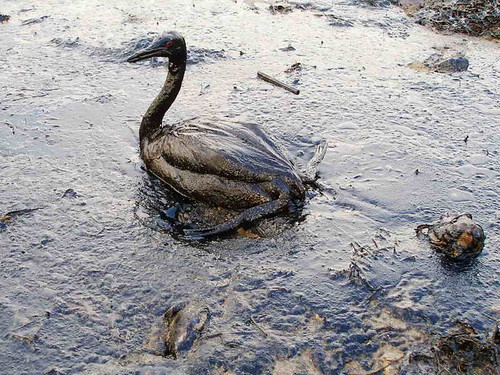
Bird covered in oil, surrounded by the spill from the *Korean Oil Spill*


This is another NY Times image from the Santa Barbara spill


Portrait of Gluttony: Death of a Creature in the Midst of an Oil Spill


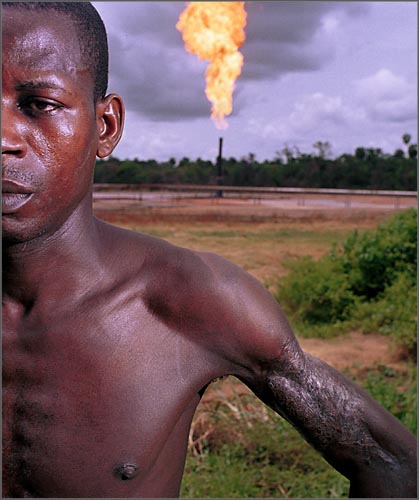
Portrait of a Future Terrorist: *The Rape of a Nation*


Please read the following article published by *LiveScience.com* on the pros and cons of drilling to better inform yourself on these issues.


Oil Drilling: Risks and Rewards

*Click here* to link to the article


By Robin Nixon, Special to LiveScience

posted: 25 June 2008 04:46 pm ET

With gas prices skyrocketing and President Bush and other politicians calling to lift a ban against offshore drilling, a polarized debate has again flared up over the true risks and rewards of this approach to oil prospecting.

"There are extremes on both sides," said Judy Penniman of the American Petroleum Institute.

A federal ban was initiated by Congress in 1981 to protect sites off California and Massachusetts and has been repeatedly expanded since then. President George H.W. Bush put his own ban in place, by executive order, in 1991, and Bill Clinton extended it to 2012. Together, the rules now thwart drilling in Alaska's oil-rich Arctic National Wildlife Refuge and elsewhere.

Scientists and politicians disagree on how much effect any new drilling might have on prices at the pump. Further, they argue about potential impacts on the ecosystem.

Impact on marine life

Concerns over new drilling amount to more than just a worry about spills.

To find potential oil reserves, researchers send seismic waves into the ground. The waves bounce back to reveal the buried topography and can hint at a possible reserve. But seismic noise disorientates whales and leads to mass beachings, said Richard Charter, a government relations consultant for the Defenders of Wildlife Action Fund.

Laboratory experiments attempting to pin down the impact of seismic waves on wildlife often must rely on caged animals, which raises questions about whether the animals would have fled and avoided ear damage if they could have, note Robert McCauley and colleagues in The Journal of the Acoustical Society of America.

However, Andy Radford, a policy advisor at the American Petroleum Institute, isn’t worried. "[We] make sure there are no whales in the area when we are doing our seismic search," Radford said.

Several weeks ago, ExxonMobil suspended exploration near Madagascar because more than 100 whales had beached themselves.

Ultimately, the seismic tests only help geologists make educated guesses. "You never know until you drill," said Eric Potter, associate director of the Bureau of Economic Geology at the University of Texas at Austin. The usual outcome is failure, Potter said, sending wildcatters back to the seismic drawing board.

Questions on land too

There are also questions about the impacts on land.

Radford described advances that reduce oil drilling’s environmental footprint. For instance, oil companies are now able to drain several oil fields from one platform. And new horizontal drilling techniques allow more oil to be extracted from a single well.

Major infrastructure – such as roads, jet landing strips, repair shops, homes and industrial complexes – is, of course, still necessary and could disturb wildlife that is accustomed to pristine land, said Charles Clusen, director of National Parks and Alaska Projects for the Natural Resources Defense Council.

Similar concerns about wildlife arose before construction of the Alaskan Pipeline, built in the 1970s.

"But there hasn't really been any effect on the wildlife; they congregate near the pipeline and it doesn't seem to bother them," said UT's Eric Potter.

However, any development of the Arctic National Wildlife Refuge (ANWR) for drilling, as President Bush has long advocated for, could have a greater impact. Polar bears, caribou and other animals trek across this unique area to give birth, said Clusen. Birth is the most vulnerable time in a species’ life cycle and disrupting it will lead to diminished populations, he explained.

The true overall environmental impact of oil drilling is hard to gauge, due to the paucity of baseline studies, said Jeff Short, a supervisory researcher for the U.S. National Oceanic and Atmospheric Administration (NOAA).

In the wild, most animals quickly flush PAH, a toxin associated with oil wells, from their bodies — which is why PAH rarely concentrates in the food web and is of minimal risk to humans. The animal’s justifiably panicked immune response to PAH can cause cancer — especially if the animal is exposed continually by, say, living near an oil platform, explained Short.

As for human populations, many coastal communities depend on tourism and fishing — both of which may be affected by off-shore drilling by increased development, pollution and disruption of marine life habitats. Among traditional communities in the ANWR, some oppose drilling while others have cautiously welcomed it — within limits — for the improved access to jobs and amenities it could bring.

Spills and transportation

"The public doesn’t have a clear idea of how much oil is moved every day," said Potter. "The amount spilled is miniscule, compared to the amount that is transported," he said.

The industry now has a great track record, said API’s Penniman. "Back in the 1880s, we would have had a pretty good chance of ruining the world," she said, but technology and safety regulations are now significantly improved.

Today, according to the Mineral Management Service, of the billions of oil transported in U.S. water, 0.001 percent is spilled. Far more oil seeps naturally into the sea, reports the National Research Council (NRC). According to the NRC's most recent analysis, almost half of oceanic oil worldwide arises from natural processes. Oil spills contribute about 12 percent.

Even so, says Clusen, there are 300 to 500 spills every year, a number which will grow with increased production.

"And once you have a spill, you are pretty much screwed," NOAA's Short said. That's because oil spreads on water at a rate of one-half a football field per second. Recovery can take decades.

After 20 years of natural weathering, Prince William Sound — the area affected by the Exxon-Valdez spill — appears completely recovered to the casual observer, said Short, but animals high up on the food chain are just now starting to re-colonize.

Even a perfectly functioning oil well is a cause of concern due to "produced water," explained Short.

Produced water — which rises with oil and contains environmental toxins such as polycyclic aromatic hydrocarbons (PAH) — is usually tossed overboard. At high concentrations, the contaminants are lethal to marine life. At lower concentrations, according to lab experiments, they can cause birth defects, impaired growth and skewed sex ratios.

Prices at the pump

Estimates for the output of oil drilling sites can only accurately be given in very large ranges, Potter explained. For example, the Energy Information Administration predicts ANWR could produce between 1.9 and 4.3 billion barrels of oil, and that might not do much for our pocketbooks. In 2007, the United States consumed 7.5 billion barrels, according to the U.S. Energy Information Administration (EIA).

In the best-case scenarios, said Clusen, "we're talking lowering the price of gas by three cents, 20 years from now."

The American Petroleum Institute is more optimistic. "When we went into Prudhoe Bay [in northern Alaska], we expected nine billion barrels, and we have already pumped 15," Radford said. And the White House estimates that lifting the drilling bans would produce an extra 18 billion barrels from various locations.

But the federal EIA sees no short-term value in additional drilling, a process that takes years for awarding contracts and obtaining permits.

"Access to the Pacific, Atlantic, and eastern Gulf regions would not have a significant impact on domestic crude oil and natural gas production or prices before 2030," the EIA states on its web site. "Leasing would begin no sooner than 2012, and production would not be expected to start before 2017."

Potter and others note that drilling that began 30 years ago, such as in Prudhoe Bay, Alaska, are helping meet today's demands.