Showing posts with label Public education. Show all posts

Wednesday, April 29, 2009

EASY ACTIVISM FROM YOUR DESK!: Healthcare Reform NOW! - for OUR future!!

Lack of knowledge on what a healthy diet consists of (therefore eating unhealthily) combined with lack of visits to the doctor due to lack of insurance, etc. to intervene before cholesterol levels get too high = artery cloggage = heart attacks = premature, unnecessary and painful death for many Americans

Dear Public,

Right now there are 2 major policy areas up for BIG reform right now that are crucially in need of reform.  This blog post is specifically on HEALTHCARE REFORM and seeks to get you up to speed with info about Obama's healthcare reform plan, why policy changes are needed NOW,  and to give you EASY methods by which you can get involved, starting with getting educated on what's going on.  You being a knowledgeable and proactive citizen is KEY to the health of the American populace! 

Healthcare policy:

The articles below have been included to give you a start on researching healthcare reform issues and Obama's plan and what it means.  To be active, do your research, think about the issues from a broad perspective (minus outdated and besides-the-point talk of socialism -- the US has been investing in the 'social' sphere for a while now), then call or email your local congressperson and tell them what you think.  You can find out how do to do that by clicking: HERE. You need to type in your full zip code and you can find that out by clicking: HERE

The links below are intended to get you started with providing you information about the need for reform.  Apparently the insurance companies are working hard to block key areas of reform that would make healthcare cheaper for you and me, but which would cost them a lot.  Please feel free to offer critiques or more information about Obama's proposed reforms in our comment box.  Thanks!

Obama's plan 

Forbes Magazine on the healthcare plan 

Democracy Now! 

MoveOn.org - Click on the link below to be active through a click!

Healthcare.change.org

Milken Institute Report on the Economic Costs of Bad Health

This is a site on stopping healthcare reform:


Comment below on one of the sites above.  Guess which one?:

One Response to “STAKEHOLDERS AGREE! (to block reform)”

  1. Mark Almberg
    April 1st, 2009 at 10:43 am

    ‘This is not the place for APHA to be’

    Dr. Quentin Young, national coordinator of Physicians for a National Health Program and past president of the American Public Health Association, has sent the following letter to the executive director of APHA, Dr. Georges Benjamin:

    March 31, 2009

    Georges Benjamin, M.D.
    Executive Director
    American Public Health Association
    800 I Street, NW
    Washington, DC 20001

    Dear Georges,

    I just learned that the American Public Health Association has joined with others in the Health Reform Dialogue coalition to issue a report on health care reform and, incidentally, that the principals of the coalition have been meeting for the past six months.

    The text of the report and the news release from APHA reinforce every fear that I have about the co-optation of the health reform movement by the for-profit, private corporations in our $2.5 trillion health system.

    This is not the place for APHA to be.

    I fear that the private interests are seeking to assert their hegemony via this route. They are taking advantage of the chaotic economy to facilitate the complete corporate takeover of the health system.

    Now is precisely the time when APHA should be leading the way to a single-payer, publicly funded health program, the very program we have supported for decades.

    Sincerely,

    Quentin D. Young, M.D., M.A.C.P.
    National Coordinator
    Physicians for a National Health Program


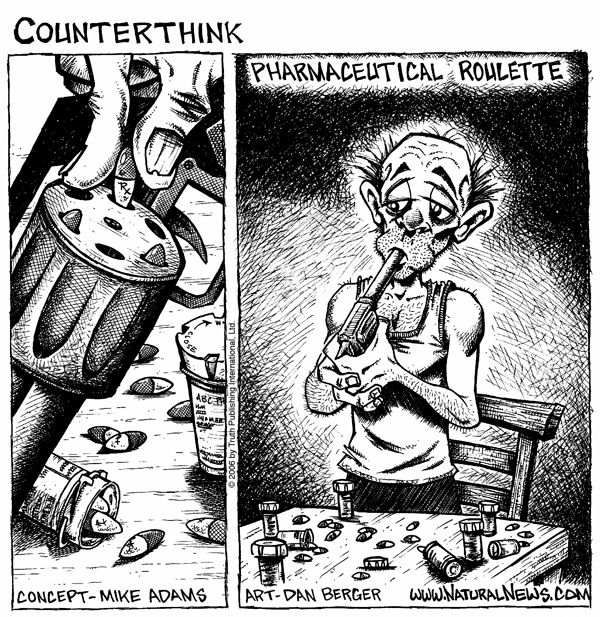
Cartoon found at: www.naturalnews.com

This cartoon has more to do with a criticism of America's addiction to pharmaceuticals and how this addiction is killing us than Obama's plan, but the cartoon still speaks directly to the market driven health industry business model, put in place during the Reagan era that has led health related companies to go on a money boom over the American people. (Market forces and corporate profits > your health). This is the core of what Obama is trying to reform through his health plan, on which he has had news online since before he became President.

Sunday, April 26, 2009

Economic Policy: 10 Big Ideas for a New America

Let's Wake Up to what's happening in the world!!!  Let's open our eyes!  Let's do it by putting down our differences and coming together for peace and prosperity!!!!


Below, please find 10 fascinating suggestions of how to renogotiate the social contract in the US.  That is to say, it is 2009 - the last serious remodeling of public investment into the social sphere occured during the last Great Depression, 80 years ago.  

You can link to the '10 Big Ideas' site by clicking HERE.  Also, check out the rest of this organization's site:  NewAmerica.net

We first present some food for thought and points of debate.  Please find the '10 Big Ideas' article below, which suggests ways to redesign how taxpayer money is spent so that all Americans can have a more equitable share of the American Pie of Wealth.    

Perhaps the set of policies suggested by these economists is what would have come out of the bailouts had we given the reigns of economic decision making to economists who spend comparatively more time contemplating the microeconomic need to invest in the People of America and the relationship between micro growth and macro growth.  It seems instead that the various players involved in finding solutions to our messed up economy have instead focused primarily on macrolevel interests, thinking that stopping macro failure by itself will solve collapses at the micro level. For people not versed in economic jargon, micro roughly translates into the economics of you and me, and macro translates roughly into the economics of government economies, big business, and international trade. So this is to say that 'solving the economic crisis' has focused on solving the collapses at the big money level and assuming that this will somehow solve issues of capital (money) scarcity at the micro level.  (Please correct us if we are wrong on any of the point contained in this paragraph.)  

A thought on this issue (up for debate with you) is that perhaps the Obama Administration got the direction of bailout money flows backwards - instead of creating a plan that urgently pumped money primarily into car companies, banks, and the financial sector while passing a set of legislation to overhaul public programs in the long-haul, perhaps the urgent flow of money could have been creatively distributed to the consumer (i.e. the people), while putting in place a long-term plan to overhaul the American economy generally, thereby getting at a reconstruction of the workings of the financial and auto industries. 

Interesting facts: thanks to the US taxpayer's generous bailouts, banks are bouncing back to booming and so are their outrageous executive salaries. What is even more interesting (found in the article that you can link to above) is that banking execs at Goldman Sachs (GS) are earning more than other banking companies. This is interesting considering that the US Treasury Secretary is linked to GS – a fact that some suspect has influenced the Obama Administration's decision to bail out AIG (while letting Lehman Bros fail), in which GS is heavily invested

Finally, while the policies suggested below are fascinating, the debate is (obviously) still open as to whether any or all of these policies would actually be good for America.  Feel free to leave suggestions or ideas in our comment box.   


Executive Summary

Ten Big Ideas for a New America

New America Foundation | February 2, 2007

The recent turnover in Congress, combined with a wide open presidential election cycle, creates a rare opportunity to bring new ideas into the political process. The spirit of this new era will be captured by those-from either party or no party-who embrace innovative yet pragmatic solutions to the foremost challenges facing our nation. We offer this collection of Big Ideas as fuel for an overdue bipartisan debate about how to update our national policies for the common good.

A PDF version of the full report can be downloaded below. To request print copies, please contact us directly. For details on the launch event for this report -- including video of the keynote addresses by Sens. Hillary Clinton (D-NY) and Lindsey Graham (R-SC) -- please click here.

Every Baby a Trust Fund Baby

An American Stakeholder Account (ASA), established for every child at birth, would build a savings and ownership culture in America, promote financial literacy, and fortify the American economy for the long haul. Every child would automatically receive a $6,000 deposit into an ASA at birth-and also be eligible for dollar-for-dollar matching funds for voluntary contributions up to $500 a year. Over time, ASAs will evolve into a broad system of saving accounts that all Americans, and especially low-income Americans, can tap to meet their asset needs throughout their lives, enabling them to invest in higher education and lifelong learning, purchase a first home, start a small business, and build a nest egg for retirement. [More on This Idea]

Mandatory, Affordable Health Insurance

We need both universal health coverage and a more efficient delivery system. These are not competing objectives; achieving each of these goals is necessary to make the other possible. The most promising and politically feasible path to universal health coverage is to make an adequate level of insurance mandatory and affordable for all individuals. The new system would be citizen-based instead of employer-based, thereby making health insurance fully portable from job to job. Once all patients are insured, providers can be expected to assist-rather than resist-the efficient redesign of our delivery system. This will entail an electronic health information superstructure, performance-based payments, and comparative technology assessment that will enable us to buy and deliver high-quality health care far more efficiently than we do today. [More on This Idea]

A Universal 401(k) Plan

For those with access, America's private pension system provides powerful saving incentives: tax breaks and employer contributions, as well as the convenience and discipline of automatic payroll deduction and professional asset management. Unfortunately, this employer-based system covers only half of all workers. Moreover, two-thirds of the tax breaks for retirement saving go to the most affluent 20 percent who would save anyway. The solution is a Universal 401(k) plan. All workers would have the option to contribute automatically to their own plan by payroll deduction-and the government would match voluntary deposits with refundable tax credits deposited directly into the worker's account. This supplemental system would make retirement saving easier, automatic, fully portable, and fair. [More on This Idea]

Tax Consumption, Not Work

For more than 70 percent of American families, the payroll tax is the largest tax they pay. Yet the tax is regressive, inefficient, and insufficient to fund the programs it finances. As a 15.3 percent wage tax levied on employers and employees, it deters job creation and depresses wages at the low end of the scale. By replacing the payroll tax with a national and progressive consumption tax, the United States could stimulate job creation, higher wages, and higher levels of personal saving at the same time, all in a revenue-neutral manner. Families would pay taxes on what they spend each year, rather than on what they earn. Higher levels of spending would be taxed at higher rates, encouraging saving, strengthening the economy, and increasing the overall progressivity of the tax code. [More on This Idea]

An Energy Efficiency Trading System

Reducing the economic and environmental risks of excessive energy use must become one of America's most important national goals. The most promising way forward is to reduce energy demand by spurring a revolution in energy efficiency. Indeed, efficiency is America's largest and most cost-effective potential energy resource. Phasing in tough new energy standards for America's biggest energy users and making energy efficiency tradable-much the way we now trade oil and natural gas-would quickly reduce total energy consumption while limiting carbon emissions. A market for standardized efficiency credits (white tags) will give utilities, builders, and vehicle manufacturers flexibility in meeting strict efficiency goals while stimulating new technologies, creating jobs, and improving the nation's overall productivity and competitiveness. [More on This Idea]

A College Access Contract

America's financial aid system imposes too much debt on college graduates, provides too much taxpayer support to banks making college loans, and demands too little of students assuming them. A new "College Access Contract" would allow low-income students to graduate with zero federal student loan debt-and middle-class students to graduate with interest-free federal student loan debt-if they: (1) work hard in high school to prepare for college-as evidenced by completing a college prep track or scoring college-ready on a placement exam; (2) work or engage in community service while in college an average ten hours a week; and (3) evidence a minimum level of competency in an academic area upon completing college. The program's cost can be paid for by reducing excess lender subsidies and embracing market mechanisms in the delivery of federal student loans. [More on This Idea]

Closing the $700 Billion Tax Loophole

While it appears the federal government will spend around $2.8 trillion this year, there is another $700 billion that is "spent" through the tax code in the form of tax expenditures. This shadow budget represents subsidies disbursed by way of taxes not collected. While politically popular, tax expenditures are an inefficient, poorly targeted, and needlessly expensive way to achieve the programmatic goals of government. Tax expenditures need to become part of the regular budget and appropriations process. They should be dramatically reduced, consolidated, and capped. The result would be a simpler, fairer, more efficient tax code. Equally important, hundreds of billions of dollars in potential savings can be freed up and redirected to meet the nation's most important needs. [More on This Idea]

Universal Risk Insurance

In recent decades there has been a massive transfer of economic risk from shared institutional arrangements, such as unemployment insurance and basic benefit coverage provided by employers, onto the fragile balance sheets of families. Yet public programs have largely failed to respond. "Universal Insurance" is a new response to this growing problem. It would provide short-term, stop-loss protection to families whose income (after taxes and public benefits) suddenly decline by a fifth or more due to job loss or catastrophic health expenses. All but the richest families would be eligible, but the program would be most generous for low-income families. This type of broad-based insurance-covering a range of risks but focused on substantial income drops or losses-would provide a flexible new platform of security in a world of rapidly changing risks. [More on This Idea]

Instant Runoff Voting

Americans want a more representative and responsive government capable of addressing the nation's challenges, yet our electoral system is founded on antiquated practices that inhibit voter choices and encourage a politics of polarization and paralysis. It's time to bring our electoral system into the 21st century by adopting instant runoff voting (IRV). IRV elects winners with majority support in a single election by allowing voters to rank a first, second, and third choice on their ballots. If no candidate wins a majority, and a voter's first choice is eliminated, the vote goes to the voter's second-ranked candidate as his or her runoff choice. IRV encourages more electoral competition, solves the "spoiler" problem, enables voters to choose the candidate they really want, and encourages candidates to win by building coalitions rather than tearing down opponents. [More on This Idea]

A Capital Budget for Public Investment

The federal budget needs to prioritize spending that will make our economy more productive in the future. Yet, over the last several decades, the portion of the federal budget going to current consumption has increased, while that devoted to public investment has declined. As a result, the federal government does not adequately fund either the physical infrastructure or knowledge capital upon which a more productive economy rests. We are underinvesting not only in traditional infrastructure, but also in high-speed broadband networks, in basic science research and development, and in training skilled workers, scientists, and engineers. Just as private businesses and most states use capital budgeting, a federal capital budget would allow us to separate our nation's public investment, which expands our capacity to grow, from our government's current consumption outlays. [More on This Idea]


Tuesday, November 25, 2008

SO YOU WANT TO KNOW ABOUT TAXES?????


Let us know what you think about this post!

The picture above comes with a story.  The story is very interesting, but also very common, sadly, for people who depend on publicly funded health insurance.  The people in the picture above are protesting the fact that private clinics such as Carle Clinic are refusing to accept public funds, which means that many people are going without healthcare.  If you depend on public healthcare, there are no clinics around directly run by the government, and private clinics refuse to accept Medicare/Medicaid, then that leaves a bunch of people totally screwed by the system that is supposed to be caring for them.

 *Click here* to read the Statements declaring the purpose of the protest above. 

This blog post will start by providing information to those who may not understand what the world is like when you depend on public (tax funded)  insurance, namely *Medicare* or *Medicaid*. If you did not know that these are the names of our public health programs, you pay all your taxes AND you fight actively to pay less taxes, then you should think twice about your logic. 

This is because:

if you know nothing about what your taxes pay for, then how can you even possibly understand what the impact is of every dollar less that you pay in taxes?

Taxes are the price that we pay to live in America.

It's the price we pay to live in our cities and in our particular neighborhoods. 

If you work hard everyday and take pride in what you do--which you should, considering that you spend all day doing it--then you should fully understand that your income taxes are going, at least in part, to fund things like the public health system

Making "change" in the system ultimately means being proactive in the system.  Being proactive means CONSTANTLY and CONSISTENTLY voicing to the government that WE WILL NOT TOLERATE failed public policies!!!

We will not tolerate a failed healthcare system!!!!  Or a failed public education system!!!!  Or any failed public entity that is supposed to be created and paid for by the people, for the people.

Fortunately for us, Obama's election changes the game a whole lot.  This man has made himself open to caring.

So, for those of us (and there really need to be MORE) who care, we can hopefully have a good shot of getting our frustrations through to an Obama Presidential administration, and enact real change.  

We must all understand that by electing Obama, we have gone through a MAJOR paradigm (era) change.  We took the red pill, we took the plunge.  We now need to SOAR with it!!  We need to start caring about each other.  

In terms of taxes, this means that we must remember and understand that our daily work pays for:

Healthcare (including mental health and dental care), schools, building roads and bridges, having/maintaining a plumbing and a sewage system (to take care of our waste and our poop), electricity, clean water that is germ free, public education campaigns (to raise awareness about things like STD's and what to do in case of a natural disaster), the salaries of public officers (police officers, politicians, people who clean our streets), the War in Iraq and Afghanistan, the War on Drugs, the cost to build a massive defense and weapons systems (including atom and hydrogen bombs), the cost to keep military bases up and running in countries around the world, funding our prisons and the death penalty, public transportation, building parks, using to conserve nature and the wilderness,  etc etc etc etc.  

The list of what our taxes pay for goes ON AND ON AND ON.  This is why it is important to be AWARE and VIGILANT.

When you pay private insurance, you are paying for insurance on top of what you already pay to the government.  

This is because public healthcare is stereotyped as being 'welfare' - only for the needy and the poor who can't afford better health services.  

The Editor of Obama IS America! argues that universal healthcare would be a good thing, even though it would require some MAJOR restructuring of our public healthcare system--which is we need to do anyway and which WE are going to have to ultimately pay for.  We should restructure our public health system in a way that incorporates ALL Americans. This would make the most sense, considering that every tax paying citizen ends up paying for it anyway through our tax system.

It makes no sense that some of us end up forking over all this money to private health companies (private meaning that a vast minority of people make a huge profit), or going without any healthcare at all when we could ALL be getting GOOD healthcare just by paying our taxes, which we have to pay anyway! 

The thing with setting up a system of universal healthcare is that we already have the groundwork set up for us, but on the small scale.  This fact is well demonstrated by the case of the Protest against Carle Clinic in Champaign, Illinois highlighted in the photo and story above. 

Private clinics can accept public money.  If they accept public money, this means that the price that they get paid per client will be lower since public funding cannot afford to pay for care in the way that private insurance can.  

Public insurance pays for the health care of people who are involved in the Medicaid/Medicare programs.  However, right now, to access these programs you either have to be under the federal poverty level, have young children, be disabled somehow, or be over the age of 65.  So, as you can imagine, this creates another problem with the Medicare/Medicaid system:

It leaves about 37 million taxpaying Americans without any health insurance whatsoever.

If you add the 9 million uninsured children to the figure above, that means that 46 million Americans are going without any healthcare whatsoever. 

This is a disgrace, especially since we are already PAYING for a healthcare system through taxes.

In general, the Editor of this blog thinks that a well planned universal healthcare system is a real possibility based on our existing healthcare structures.  It could mean that EVERYONE would be taken care of, and the treatment we'd get would be GOOD!  We just have to make sure that the program is well designed, not overly (and unnecessarily bureaucratic), is actually in the interest of ALL the people, and has good oversight. 

As a united voice, the American people can pretty much work together on anything and have it be good.  So why not work together to build a new, sustainable, fair, and well-structured public health system?

It has yet to be seen whether or not Obama truly does care about making fundamental changes for American growth in a positive direction.   His stances are especially important considering how bad things are right now in certain ways...
  • Racial rioting is as bad as ever if not WORSE for some communities, like the Latino community, which has seen a *RISE* in hate crimes over the last year.  In New York, an Ecuadorean man who had been in the US for 20 years got STABBED TO DEATH by seven teenagers, because some kids were out looking to *kill a Mexican*.
  • The American economy is in the dumps right now, we are at the brink of failure as a nation, and we--like big dolts--keep pumping money into the pocketbooks of rich bankers and jet flying auto-makers who want US to pay for their failures.
  • We are at war, and have caused the mass killings of millions of people across the planet, sparking an all out global WAR on terrorism, which is supported at home by hateful rhetoric toward Muslims, Muslim looking people like Sikhs (who aren't even Muslim at all--Sikhism is its own religion).

Times are crazy!

And Obama happens to be the man in the middle, holding everyone together with his message of hope--and WE are the ones that have to make sure he gets the job done, and gets it done well.

THIS CANNOT BE EMPHASIZED ENOUGH : CHANGE WILL NOT HAPPEN UNLESS WE GET INVOLVED IN THE FUNCTIONING OF OUR OWN GOVERNMENT, 

which translates into : THE FUNCTIONING OF OUR OWN LIVES!!  

WE NEED TO START TAKING SOME RESPONSIBILITY FOR THE STUFF GOING ON IN THE WORLD THAT WE DON'T LIKE IF WE WANT THINGS TO GET ANY BETTER!!!!!!


So the point of this blog post ultimately is:

BE AWARE of where your money goes, especially when you fork out a large chunk of your monthly paycheck to TAXES!!

Pay attention to the things going on in your life, and all of the world around you!!

Be considerate of the other people around you, and how they you, your opinions, and the things that you value affect them.

Also, please click on the links above and check out the sites they lead to.  They have been included to take you to the source sites, which can provide you with lots of interesting information.

DON'T HATE, EDUCATE!
DON'T HATE, COMMUNICATE!

YEAH!!!!